Skip to content

Experience the future of energy with Parachew, powered by pure paraxanthine.

Parachew, Energy Delivered

The Science

Caffeine is not the molecule that wakes you up.

Your liver has to convert it first. About 84% of that conversion produces one compound, paraxanthine, and paraxanthine is what Parachew delivers directly. This page walks through the chemistry, the mechanisms, and what the human trials found, with every source cited.

84%

of caffeine demethylation yields paraxanthine 2

200mg

enfinity paraxanthine per gummy, the dose used in the human trials 9

3.1h

paraxanthine half-life, against 4.1 h for caffeine 1

Step one

Caffeine behaves like a prodrug

Caffeine is 1,3,7-trimethylxanthine. When you drink it, it is pharmacologically active in its own right, but it is also rapidly demethylated in the liver, overwhelmingly by the cytochrome P450 enzyme CYP1A2. That reaction strips one of the three methyl groups off the xanthine core, and which methyl group comes off determines which of three different compounds you end up with.

This is not a minor metabolic footnote. In the definitive human study, five subjects dosed to steady state converted caffeine to paraxanthine, theobromine and theophylline in a ratio of roughly 84 to 12 to 4 when only the demethylation pathways are counted. The partial clearance of caffeine to paraxanthine was about 8 times greater than to theobromine and about 23 times greater than to theophylline.2

So the compound circulating in your blood after a coffee is substantially paraxanthine. The authors of that study concluded that paraxanthine formation is quantitatively more important than had previously been believed. Parachew's premise is simply to start at that step instead of waiting for it.

A separate crossover study in humans put the average conversion at 80% and established that paraxanthine is pharmacologically active in its own right, not an inert breakdown product on the way out. Its activity, the authors wrote, has to be accounted for in any proper understanding of what caffeine does.4

Skeletal structure of caffeine, 1,3,7-trimethylxanthine, showing methyl groups on ring nitrogens 1, 3 and 7N1N3N7N9OOCH3CH3CH3

Caffeine

1,3,7-trimethylxanthine

Three methyl groups, on ring nitrogens 1, 3 and 7. CYP1A2 removes one of them. Which one it removes decides which compound you get, and the naming follows directly: lose the methyl at N3 and the two that remain are at N1 and N7, so the product is 1,7-dimethylxanthine.

Step two

The three compounds caffeine becomes

Each is a dimethylxanthine. They differ only in which methyl group was removed, and they behave very differently as a result.

Caffeine1,3,7-trimethylxanthine
CYP1A2, hepatic N-demethylation
Paraxanthine 83.9%Theobromine 12.1%Theophylline 4.0%

Proportions of caffeine demethylation, measured at steady state in five subjects. Counting all clearance routes rather than demethylation alone, the fractional conversion of caffeine to paraxanthine was 79.6%. 2

Skeletal structure of Paraxanthine, 1,7-dimethylxanthine. The methyl group removed from caffeine at position 3 is shown dashed.N1N3N7N9OOCH3CH3CH3

Paraxanthine

83.9%

1,7-dimethylxanthine · ± 5.4% of demethylation

Half-life
3.1 h
Clearance
2.20 mL/min/kg

The dominant metabolite and the one with the psychostimulant profile closest to what people actually want from caffeine. It antagonises adenosine A1 and A2A receptors, and preclinical work indicates it does so with higher potency than caffeine itself. It also runs a second mechanism that caffeine did not show in the same experiments, described below. It is cleared faster than caffeine and considerably faster than the other two metabolites.

No common dietary source. It exists in you almost entirely because you drank caffeine.
Skeletal structure of Theobromine, 3,7-dimethylxanthine. The methyl group removed from caffeine at position 1 is shown dashed.N1N3N7N9OOCH3CH3CH3

Theobromine

12.1%

3,7-dimethylxanthine · ± 4.1% of demethylation

Half-life
7.2 h
Clearance
1.20 mL/min/kg

A much weaker central stimulant than caffeine or paraxanthine, with more of its activity showing up as smooth muscle relaxation and mild diuresis. Its half-life is more than double paraxanthine's, so it lingers long after the subjective effect of a coffee has gone. It is a minority product of caffeine metabolism, not a main event.

The principal methylxanthine in cocoa and dark chocolate.

Skeletal structure of Theophylline, 1,3-dimethylxanthine. The methyl group removed from caffeine at position 7 is shown dashed.N1N3N7N9OOCH3CH3CH3

Theophylline

4.0%

1,3-dimethylxanthine · ± 1.4% of demethylation

Half-life
6.2 h
Clearance
0.93 mL/min/kg

The smallest fraction by a wide margin, and the one with the narrowest therapeutic window when it is used as a drug in its own right. It is the slowest cleared of the four compounds. At the quantities generated from ordinary caffeine intake it contributes very little to how a coffee feels.

Found in tea, and used clinically as a bronchodilator.

Comparative pharmacokinetics

All four compounds, measured head to head

Six healthy male volunteers, each compound given orally on separate occasions. This is the study the half-life numbers on this page come from. 1

0%25%50%75%100%0h2h4h6h8h10h12h50% remainingTheobromine7.2 hTheophylline6.2 hCaffeine4.1 hParaxanthine3.1 hHours after a single oral dose
CompoundHalf-lifeTotal plasma clearanceVd at steady state
Caffeine4.1 h2.07 mL/min/kg0.63 to 0.72 L/kg
Paraxanthine3.1 h2.20 mL/min/kg0.63 to 0.72 L/kg
Theophylline6.2 h0.93 mL/min/kg0.44 L/kg
Theobromine7.2 h1.20 mL/min/kg0.63 to 0.72 L/kg

Paraxanthine is the shortest-lived of the four at 3.1 hours, so it clears rather than lingers. Theobromine and theophylline, the two metabolites you also generate every time you drink caffeine, stay in circulation roughly twice as long.

Mechanism

How paraxanthine acts

Both compounds block adenosine. Only paraxanthine took a second route in the experiments that tested for one.

Caffeine

One route

Antagonises adenosine A1 and A2A receptors

Sleep pressure signalling is blocked

Alertness, reduced perception of fatigue

In the same rat experiments, caffeine did not raise striatal cGMP and did not significantly increase extracellular dopamine. A PDE9 inhibitor given alongside it increased caffeine's locomotor effect, which is what you would expect if that route were still available rather than already in use. 7

Paraxanthine

Two routes

Shared with caffeine

Antagonises adenosine A1 and A2A receptors

Higher potency at A1 and A2A than caffeine

Sleep pressure signalling is blocked

Alertness, reduced perception of fatigue

Its own, rat data

Inhibits cGMP-preferring PDE9

cGMP accumulates in the striatum

Nitric oxide signalling is potentiated

Blocked by the NO synthase inhibitor L-NAME

Extracellular dopamine increases

Dorsolateral striatum, in vivo microdialysis

Rats trained to recognise caffeine generalised poorly to paraxanthine, which is the behavioural evidence that something beyond adenosine antagonism is doing the work. 7

01Rodent receptor and behavioural data

Adenosine receptor antagonism

Adenosine accumulates through the waking day and promotes sleep pressure by acting at A1 and A2A receptors. Caffeine and paraxanthine both compete for those receptors non-selectively, which is the shared basis of their stimulant effect. Paraxanthine is reported to have higher potency at A1 and A2 receptors than caffeine, and in rats its locomotor activating doses counteract an A1 agonist more efficiently than an A2A agonist. In a narcoleptic mouse model, paraxanthine's wake-promoting effect was greater and longer lasting than an equimolar dose of caffeine. 67

02Rat, in vivo microdialysis and ex vivo

PDE9 inhibition, cGMP, and striatal dopamine

This is where paraxanthine and caffeine separate mechanistically, and it is the most interesting result in the literature. In rats trained to discriminate caffeine, paraxanthine generalised poorly to it, implying a mechanism beyond adenosine antagonism. Blocking nitric oxide synthase with L-NAME reduced paraxanthine's locomotor effect but not caffeine's. A selective PDE9 inhibitor increased caffeine's locomotor effect but not paraxanthine's, consistent with paraxanthine already acting there. Paraxanthine, but not caffeine, produced cGMP accumulation in the striatum, and paraxanthine, but not caffeine, significantly raised extracellular dopamine in the dorsolateral striatum, an effect abolished by L-NAME. 7

03Human pharmacokinetics

A shorter tail

Paraxanthine's 3.1 hour half-life is the shortest of the four methylxanthines, against 4.1 hours for caffeine, 6.2 for theophylline and 7.2 for theobromine. In practice, taking caffeine means also carrying its longer-lived minor metabolites; taking paraxanthine directly does not generate them. In a 2026 crossover trial in rowers, conditions containing caffeine were associated with poorer subjective sleep quality while paraxanthine alone showed more favourable sleep-related outcomes. 115

Why the starting point matters

The conversion step is the variable one

CYP1A2 activity is not a constant. It varies substantially between individuals, and it is induced or inhibited by things people do every day. Cimetidine, for one worked example, cut paraxanthine plasma clearance by 30% in a controlled study. The paraxanthine to caffeine ratio is itself the standard biomarker used to phenotype a person's CYP1A2 activity, which tells you how much that conversion rate is expected to differ from person to person.35

That variability sits between a coffee and its effect. Two people drinking identical coffees do not produce identical amounts of paraxanthine, at identical rates, and they do not clear the residual caffeine at the same speed either.

Supplying paraxanthine directly takes that step out of the sequence. There is no conversion to wait on, and no enzyme whose speed decides how much of the active compound you end up with, because the active compound is what you took. The variability CYP1A2 introduces sits upstream of paraxanthine, and starting below it is the entire design.

Human evidence

The four published human trials

All four are randomised, double-blind crossover designs, and three of the four used 200 mg, the dose in one Parachew gummy. Across them, paraxanthine improved executive function, reaction time and sustained attention. In the trial that ran both compounds after a hard 10 km, paraxanthine improved accuracy while caffeine's error rate climbed.

Cognition2021

Acute 200 mg, cognition and sustained attention 9

Sample
13 healthy adults
Dose
200 mg enfinity paraxanthine vs placebo
Design
Double-blind, placebo-controlled, randomised crossover. Testing at baseline and hourly to 6 h.
  • Berg-Wisconsin Card Sorting: 4.7 fewer errors at 6 h (p = 0.04) and 2.2 fewer perseverative errors (p = 0.03)
  • Go/No-Go: 15.4 ms faster Go-task response at 1 h (p = 0.03)
  • Sternberg six-letter absent reaction time: 86.5 ms faster at 2 h (p = 0.03)
  • No subjective side effects or adverse events reported
Dose response2021

50, 100 and 200 mg, acute and 7 days 10

Sample
12 healthy adults
Dose
Placebo, 50 mg, 100 mg, 200 mg enfinity paraxanthine
Design
Double-blind, placebo-controlled crossover, four conditions, plus a 7-day supplementation phase.
  • Improvements on card sorting, Go-task speed and Sternberg performance
  • 200 mg improved 2-letter Sternberg reaction times and psychomotor vigilance on later trials
  • Clean clinical chemistry, complete blood counts and lipid panels at every dose, acute and after 7 days
  • Side effects infrequent and minimal in severity, with no withdrawals
Exercise + cognition2024

Cognitive function after a 10 km run 13

Sample
12 trained runners
Dose
400 mg placebo; 200 mg caffeine; 200 mg enfinity paraxanthine; 200 mg paraxanthine + 200 mg caffeine
Design
Double-blind, randomised crossover, four conditions, 7 to 14 day washout. Tested before dosing, 60 min after dosing, and after a competition-pace 10 km treadmill run.
  • Paraxanthine increased card-sorting correct responses from pre-exercise to post-exercise by 6.8% (p = 0.012)
  • Caffeine's error rate rose 31.5% post-exercise (p = 0.02); paraxanthine's post-exercise perseverative errors were 26.9% lower than caffeine's (p = 0.026)
  • Post-exercise mean reaction time was 23.2% faster than placebo (p = 0.029)
  • Adding caffeine to paraxanthine provided no additional benefit and was 29.6% slower than paraxanthine alone on reaction time (p = 0.006)
Performance + sleep2026

2000 m rowing time trial and sleep quality 15

Sample
14 male university rowers
Dose
Caffeine + paraxanthine; caffeine + placebo; paraxanthine + placebo; placebo
Design
Randomised, double-blind crossover, four conditions at 200 mg each.
  • Paraxanthine alone showed more favourable sleep-related outcomes than the caffeine conditions
  • Combining caffeine with paraxanthine produced the fastest 2000 m time and the highest mean power against placebo (p = 0.044, Cohen's d = 0.30)
  • The authors point to paraxanthine as a practical option for athletes who prioritise sleep quality, and for evening training

The headline finding here is tolerability. Paraxanthine delivered its effect without the sleep cost the caffeine conditions carried, which is exactly what makes it workable for training or working late.

Preclinical

What the animal models show

Rodent studies are where paraxanthine has been compared with caffeine head to head, under controls no human trial can apply. They are the source of the mechanistic case, and each is labelled by species so you can see exactly what was measured and in what.

Memory and BDNF in rats

Paraxanthine at the higher dose improved Morris water maze escape latency compared with caffeine in both young and aged rats (p < 0.001 and p = 0.003), and raised whole-brain BDNF to a greater extent than caffeine (p = 0.03). 14

Muscle mass, strength and endurance in mice

Four weeks at a human-equivalent dose of about 100 mg increased forelimb grip strength 17%, treadmill performance 39%, and soleus mass 41% against control, alongside improvements in lipid markers. Compared against L-theanine, alpha-GPC and taurine. 11

Wake promotion and anxiety in mice

Wake-promoting potency exceeded equimolar caffeine and lasted longer. Higher doses of caffeine, but not paraxanthine, induced hypothermia and reduced locomotor activity. Behavioural testing found paraxanthine induced less anxiety than caffeine. 6

Safety and toxicology

What the toxicology packages found

Two independent toxicology batteries have been run on paraxanthine to international guideline standards. One of them tested enfinity, the exact ingredient in Parachew. The other tested a different manufacturer's paraxanthine head to head against caffeine, which makes it the more informative of the two for a comparative claim.

On enfinity specifically 8

  • No evidence of mutagenicity in a bacterial reverse mutation test or an in vitro mammalian chromosomal aberration test
  • No evidence of genotoxicity in an in vivo mammalian erythrocyte micronucleus test or an in vitro mammalian cell gene mutation test
  • Acute oral LD50 of 1601 mg/kg body weight per day
  • No mortality or toxic effects in 28-day or 90-day repeated-dose studies at 75, 150 or 300 mg/kg/day
  • NOAEL at or above 300 mg/kg/day, the highest dose tested, in male and female Wistar rats

Head to head against caffeine 12

  • No genetic toxicity or mutagenicity in the in vitro battery
  • Acute oral LD50 of 829.20 mg/kg body weight
  • In the 90-day study, mortality occurred in two animals in the high-dose caffeine group; none in the paraxanthine groups
  • NOAEL was 150 mg/kg for caffeine and 185 mg/kg for paraxanthine, in male and female Sprague Dawley rats
  • The authors concluded that paraxanthine could be a safer alternative to caffeine in humans

Head to head

No observed adverse effect level

No observed adverse effect level, 90-day repeated-dose oral toxicity, both compounds run in the same study on the same rat strain. Separately, the toxicology package on enfinity itself returned a NOAEL at or above 300 mg/kg/day, the highest dose it tested, in Wistar rats.

On the two LD50 figures

The two packages report acute oral LD50 values of 1601 and 829.20 mg/kg. They ran at different laboratories, in different rat strains, on different paraxanthine material, so they are separate measurements rather than one number. Both sit orders of magnitude above the exposure from a 200 mg serving.

In humans

The human safety picture is clean. No significant differences from placebo in clinical chemistry, complete blood count or lipid panels after acute and 7-day dosing, and no adverse effects on stimulant side-effect ratings or clinical blood markers in the exercise trial. 1013

In the jar

What Parachew actually contains

One gummy, both flavours identical. The paraxanthine is enfinity, which is the material used in the human trials and the toxicology package cited above.

enfinity® paraxanthine

The same dose used in the 2021 acute cognition trial and the 2024 exercise trial.

200 mg

Vitamin B12 (as cyanocobalamin)

1042% of the Daily Value. A second active that is easy to miss on the panel.

25 mcg
VeganNut freeGluten freeSoy freeDairy free
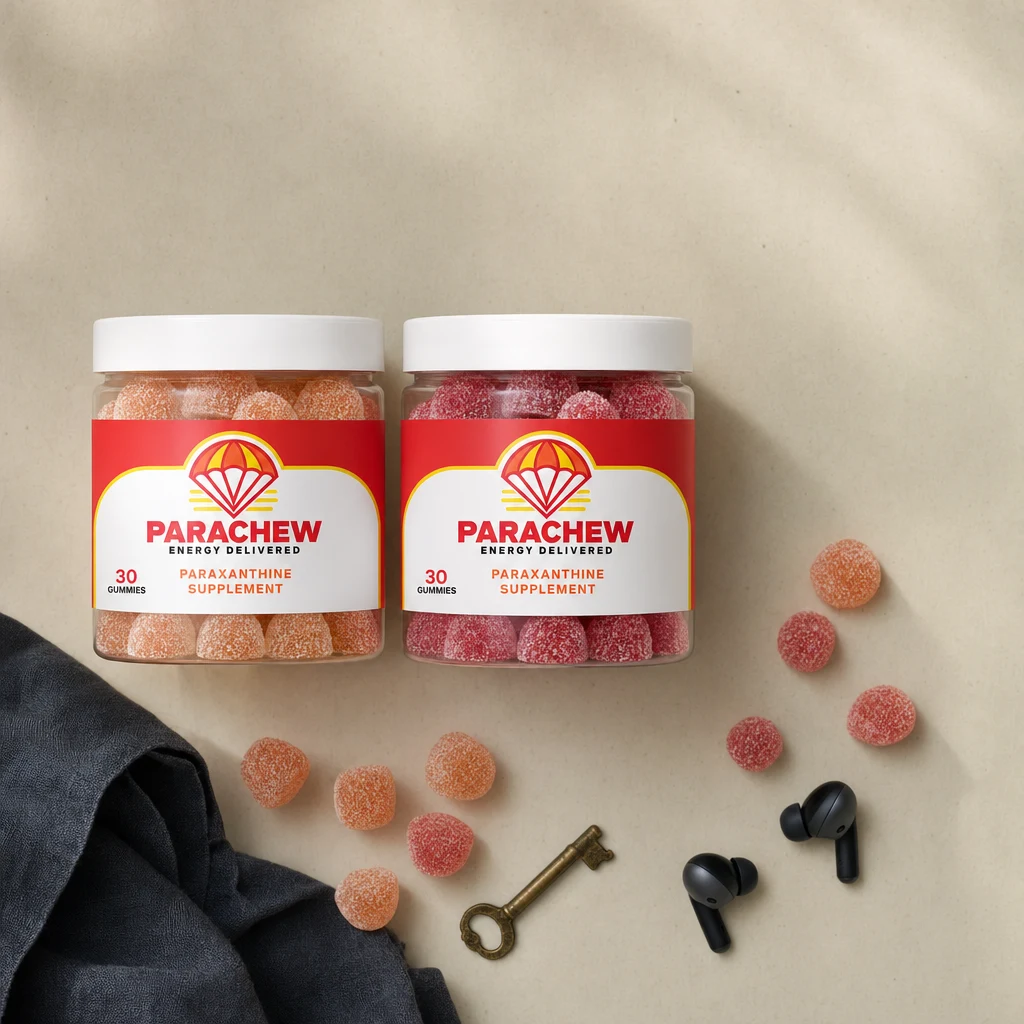
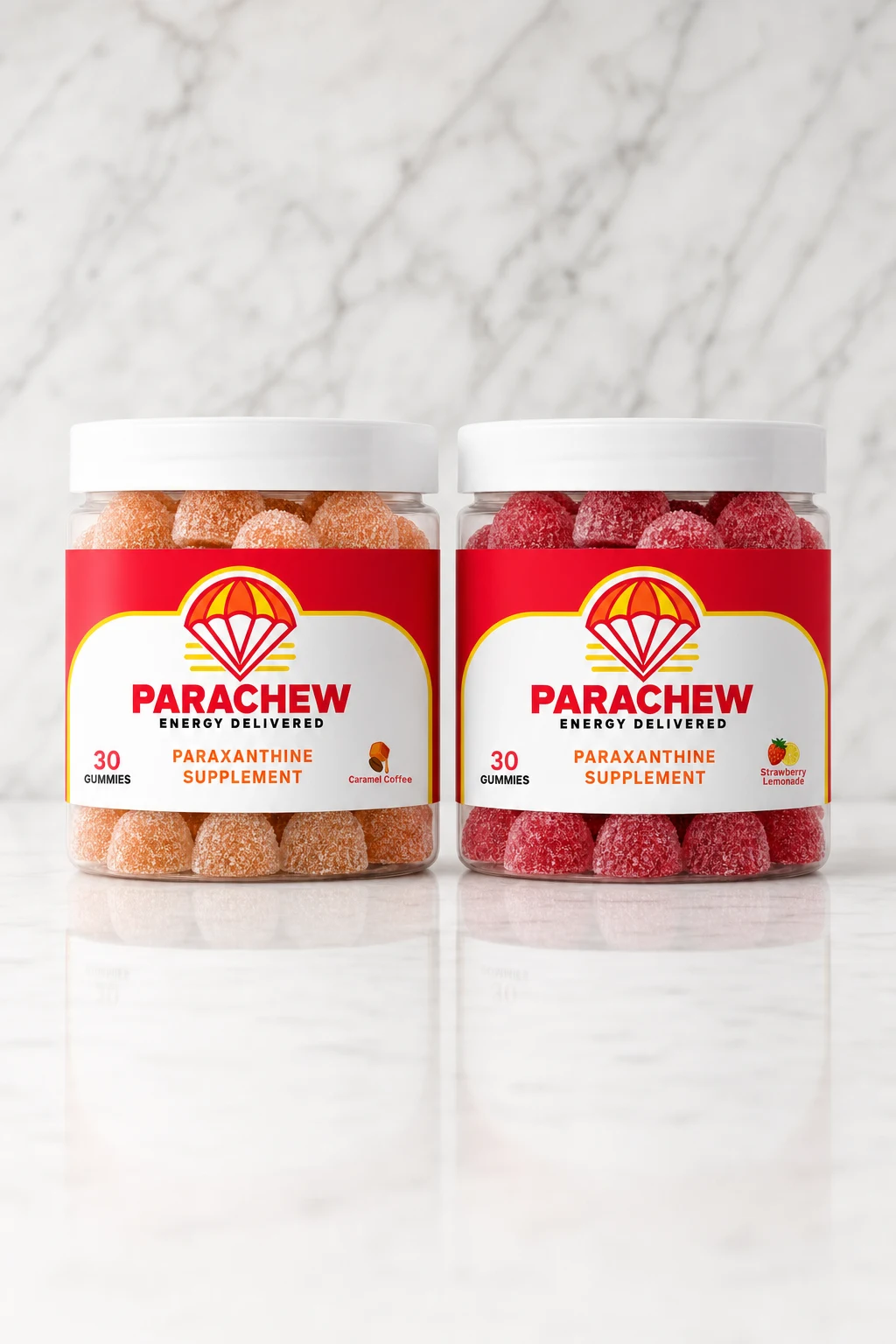
Two Parachew jars side by side, Caramel Coffee and Strawberry Lemonade

Dosing, from the label

  • 1 to 2 gummies per day
  • Do not exceed 400 mg paraxanthine per day, which is 2 gummies
  • Not for use with caffeine or other stimulants
  • Not recommended for children, for pregnant or nursing women, or for individuals sensitive to caffeine. Not for persons under 18.
See the full supplement panel

30 gummies per jar, $34.99

Who this is relevant to

Where the difference should matter most

A group of people using Parachew through a working day

People who metabolise caffeine unpredictably

CYP1A2 activity varies widely between people, and it is the step that turns caffeine into the compound doing most of the work. Paraxanthine does not need that step at all, so how fast you happen to metabolise caffeine stops being the thing that decides what you get. 5

Anyone training or working in the evening

Paraxanthine is the shortest-lived of the four methylxanthines at 3.1 hours, and in the 2026 rowing trial the caffeine conditions were associated with poorer subjective sleep quality while paraxanthine alone was not. 115

Endurance athletes who need judgement late in an event

The 10 km run trial is the most directly relevant published work here: paraxanthine improved post-exercise executive function and reaction time where caffeine's error rate increased, and stacking caffeine on top made reaction time worse rather than better. 13

Knowledge workers running long attention blocks

The acute trial's effects showed up across a 6 hour window, including reduced card-sorting errors at the 6 hour mark and sustained psychomotor vigilance where placebo deteriorated. 9

Go deeper

Further reading

Longer treatments of individual sections above, from our library.

Sources

References

15 primary sources. Every citation was checked against its PubMed record on 18 August 2026, and each is tagged with the species it was run in.

  1. 1

    Comparative pharmacokinetics of caffeine and its primary demethylated metabolites paraxanthine, theobromine and theophylline in man

    Lelo A, Birkett DJ, Robson RA, Miners JO

    British Journal of Clinical Pharmacology 1986;22(2):177-82

  2. 2

    Quantitative assessment of caffeine partial clearances in man

    Lelo A, Miners JO, Robson RA, Birkett DJ

    British Journal of Clinical Pharmacology 1986;22(2):183-6

  3. 3

    Paraxanthine metabolism in humans: determination of metabolic partial clearances and effects of allopurinol and cimetidine

    Lelo A, Kjellen G, Birkett DJ, Miners JO

    Journal of Pharmacology and Experimental Therapeutics 1989;248(1):315-9

  4. 4

    Sympathomimetic effects of paraxanthine and caffeine in humans

    Benowitz NL, Jacob P 3rd, Mayan H, Denaro C

    Clinical Pharmacology and Therapeutics 1995;58(6):684-91

  5. 5

    Simple and reliable CYP1A2 phenotyping by the paraxanthine/caffeine ratio in plasma and in saliva

    Fuhr U, Rost KL

    Pharmacogenetics 1994;4(3):109-16

  6. 6

    Effects of paraxanthine and caffeine on sleep, locomotor activity, and body temperature in orexin/ataxin-3 transgenic narcoleptic mice

    Okuro M, Fujiki N, Kotorii N, Ishimaru Y, Sokoloff P, Nishino S

    Sleep 2010;33(7):930-42

  7. 7

    Psychostimulant pharmacological profile of paraxanthine, the main metabolite of caffeine in humans

    Orrú M, Guitart X, Karcz-Kubicha M, Solinas M, Justinova Z, Barodia SK, Zanoveli J, Cortes A, Lluis C, Casado V, Moeller FG, Ferré S

    Neuropharmacology 2013;67:476-84

  8. 8

    An assessment of mutagenicity, genotoxicity, acute-, subacute and subchronic oral toxicity of paraxanthine (1,7-dimethylxanthine)

    Purpura M, Jäger R, Falk M

    Food and Chemical Toxicology 2021;158:112579

  9. 9

    Acute paraxanthine ingestion improves cognition and short-term memory and helps sustain attention in a double-blind, placebo-controlled, crossover trial

    Yoo C, Xing D, Gonzalez D, Jenkins V, Nottingham K, Dickerson B, Leonard M, Ko J, Faries M, Kephart W, Purpura M, Jäger R, Wells SD, Liao K, Sowinski R, Rasmussen CJ, Kreider RB

    Nutrients 2021;13(11):3980

  10. 10

    Dose-response of paraxanthine on cognitive function: a double blind, placebo controlled, crossover trial

    Xing D, Yoo C, Gonzalez D, Jenkins V, Nottingham K, Dickerson B, Leonard M, Ko J, Faries M, Kephart W, Purpura M, Jäger R, Wells SD, Liao K, Sowinski R, Rasmussen CJ, Kreider RB

    Nutrients 2021;13(12):4478

  11. 11

    Paraxanthine supplementation increases muscle mass, strength, and endurance in mice

    Jäger R, Purpura M, Wells SD, Liao K, Godavarthi A

    Nutrients 2022;14(4):893

  12. 12

    Paraxanthine safety and comparison to caffeine

    Szlapinski SK, Charrette A, Guthrie N, Hilmas CJ

    Frontiers in Toxicology 2023;5:1117729

  13. 13

    Paraxanthine provides greater improvement in cognitive function than caffeine after performing a 10-km run

    Yoo C, Xing D, Gonzalez DE, Jenkins V, Nottingham K, Dickerson B, Leonard M, Ko J, Lewis MH, Faries M, Kephart W, Purpura M, Jäger R, Wells SD, Liao K, Sowinski R, Rasmussen CJ, Kreider RB

    Journal of the International Society of Sports Nutrition 2024;21(1):2352779

  14. 14

    Paraxanthine enhances memory and neuroplasticity more than caffeine in rats

    Jäger R, Abou Sawan S, Orrú M, Tinsley GM, Purpura M, Wells SD, Liao K, Godavarthi A

    Experimental Brain Research 2024;243(1):8

  15. 15

    Comparative effects of caffeine and paraxanthine on rowing performance and sleep quality: a randomized crossover study

    Bingol Diedhiou A, Yildirim UC, Ozdenk S, Erkan D, Karakulak I, Yildirim Tuncer S, Turğut M, Gundem MC, Bora MV, Akca F

    Journal of the International Society of Sports Nutrition 2026;23(1):2650339

These statements have not been evaluated by the Food and Drug Administration. This product is not intended to diagnose, treat, cure, or prevent any disease. Parachew is a dietary supplement, not a medicine. Nothing on this page is medical advice. If you are pregnant or nursing, under 18, sensitive to caffeine, or taking medication that interacts with CYP1A2 substrates, talk to a clinician before using a paraxanthine product.