
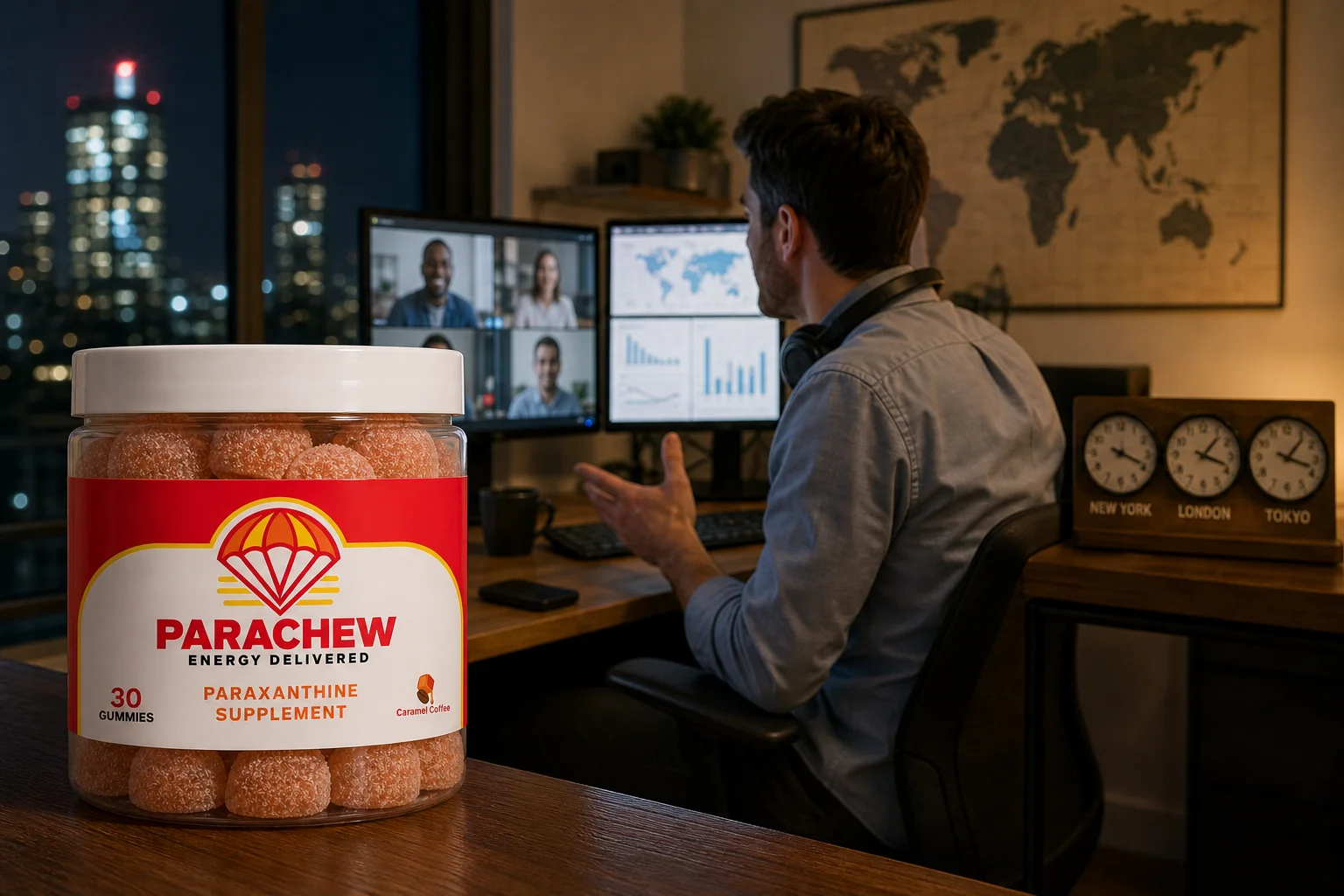
Paraxanthine for remote workers solves a problem caffeine never could: staying sharp for a 7am standup and a 9pm client call without a jittery crash in between. Paraxanthine, the compound behind Parachew energy gummies, delivers steady energy and focus across shifting schedules and time zones.
By Parachew Team, McAb Nutra
Why Time Zone Switching Breaks Your Energy Rhythm
Remote work erased the traditional nine-to-five, but it did not erase your body's internal clock. When your calendar spans three or four time zones, your energy and alertness get pulled in directions your circadian rhythm was never built for. Early research, including animal and human work on caffeine metabolites, points to how disrupted sleep timing throws off alertness and mental sharpness the next day. Reaching for coffee or an energy drink to force your way through a late call often backfires: it spikes energy for an hour, then drops you into a crash right when you need to sound clear and present on a video call. The problem compounds the longer a remote or hybrid schedule runs. A single late night is manageable, but a recurring pattern of 9pm calls or early 6am syncs wears down the same energy reserves your body relies on for focus during the rest of the day. Given the demands of back-to-back meetings across shifted hours, distributed teams need a source of energy that holds steady instead of yanking focus up and down all day, one that supports the body's own rhythm rather than fighting against it.
How Paraxanthine for Remote Workers Compares to Caffeine
Paraxanthine is the primary metabolite caffeine leaves behind once your liver processes it, and that caffeine paraxanthine conversion happens whether you drank coffee at 6am in Denver or 6pm in Berlin. The paraxanthine caffeine comparison matters here: researchers have compared caffeine and paraxanthine directly, and the differences show up in receptor activity and reported side effects. Caffeine blocks adenosine receptors broadly and can leave some people wired, anxious, or unable to wind down after a late call. Paraxanthine engages those same adenosine receptors but is associated with fewer reported side effects like jitters or a racing heart, which is exactly why it holds up better for people juggling odd hour meetings. That difference is the whole reason paraxanthine for remote workers has become a swap worth making: you get the alertness without the trade off of feeling strung out three hours before you're supposed to sleep.
Supporting Cognitive Function During Odd Hour Meetings
A 9pm client call is not the time to feel foggy. Paraxanthine supports cognitive function by working on adenosine receptors in the brain, the same receptors that build up sleep pressure signals and make you feel drowsy as the day wears on. By moderating that signal, paraxanthine helps keep mental clarity and reaction time steady even when your body thinks it should already be winding down. Users report that focus energy stays level through a late call instead of spiking hard and dropping off twenty minutes later. That steadier curve matters for reaction time in particular: quick, clear responses on a video call read very differently than a sluggish, delayed one. For anyone stacking meetings across a compressed evening window, that combination of alertness and calm focus is the practical benefit paraxanthine brings to the table, and it is the same mechanism that supports mental clarity during any long stretch of screen time, not just calls.

Paraxanthine vs Energy Drinks for Distributed Teams
Energy drinks are the default reach for a lot of remote workers trying to push through a late shift, but most are loaded with high dose stimulants and added sugar that spike energy fast and drop it faster. That pattern gets worse the more time zones you're juggling, because your body is already working overtime to manage a shifted sleep and wake schedule. Paraxanthine works differently: it supports steady energy without depending on the same stimulant load that energy drinks and coffee stack on top of your existing caffeine metabolism. Each dose from the Parachew gummy formula delivers 200mg of paraxanthine, and the label caps daily intake at two gummies, or 400mg, so you get a clear, predictable dose instead of guessing how much caffeine is hiding in a can. That predictability is one of the practical benefits remote and hybrid teams lean on when performance needs to hold across a full day of shifted meetings.
Building a Time Zone Proof Focus Routine With Paraxanthine
Paraxanthine for remote workers works best as part of a routine, not a one off fix for a rough week. If your schedule rotates or flips overnight shifts into daytime hours, the useful anchor point is not the wall clock but your own wake and sleep windows: time the dose relative to when you got up, and stop dosing early enough that it clears well before your intended wind down, even when that wind down lands at an unconventional hour. That kind of planning is easiest with a dose timing calculator built around your actual rotation instead of a fixed clock time. Distributed teams juggling literal shift work face a related challenge: performance consistency depends less on which time zone a meeting falls in and more on keeping the same dose-to-wake interval every rotation, so the body gets a stable cue even when the shift itself moves. Rotation length varies by team, but the same dose-to-wake interval carries through rotating shift schedules regardless of how the hours move. For knowledge workers protecting long blocks of deep, uninterrupted work, the same adenosine receptor mechanism that keeps a late call sharp also holds up over a multi-hour block: timing the dose to the start of that block, rather than partway through, keeps the moderation effect active for the whole stretch instead of tapering off before the work is done. That start-of-block timing is the backbone of any focus block protocol built for a full uninterrupted session. And if your energy dips hardest in the mid afternoon before an evening call block even starts, that afternoon dip and the evening slump are usually the same underlying timing gap rather than two separate problems, so one well-placed dose in the early afternoon can carry through both instead of requiring a second. Recognizing that pattern is the first step before addressing a mid-afternoon energy dip with extra gummies you may not actually need. As a supplement, paraxanthine is simple to build into any of these routines: one gummy when you need mental clarity to kick in, a second only if the label allows it, and a drink of water alongside it.
Frequently Asked Questions
Does paraxanthine cause side effects like caffeine does? Paraxanthine is associated with fewer reported side effects than caffeine, including less jitteriness, anxiety, and the kind of racing heart feeling that can come with a strong cup of coffee or an energy drink. As the primary metabolite caffeine converts into naturally inside your body, paraxanthine engages adenosine receptors more gently. That is why many remote workers find it easier to use later in the day without disrupting sleep or feeling wired hours afterward.
How is paraxanthine different from caffeine in energy drinks? Most energy drinks rely on caffeine alone, often in high doses, which can cause a fast spike in energy followed by a hard crash. Paraxanthine is the compound your body naturally produces from caffeine metabolism, and research suggests it supports steadier alertness and reaction time without the same sharp swing. For remote workers stacking calls across a long shift, that steadiness matters more than a short burst.
Can paraxanthine help with rotating schedules or working across time zones? Yes. Because paraxanthine supports steady focus energy without the sharp crash often tied to caffeine, it can help remote workers hold cognitive function steady when a call schedule cuts across time zones or a shift rotates unexpectedly. Pairing a dose with consistent sleep timing, even when that timing shifts week to week, gives your body's rhythm something stable to work with.
How much paraxanthine is in each Parachew gummy? Each Parachew gummy contains 200mg of paraxanthine. The label caps daily intake at two gummies, or 400mg, so remote workers get a clear, consistent dose instead of estimating how much caffeine they are pulling in from coffee, energy drinks, or other sources throughout a shifted schedule. That predictability is part of what makes it easy to plan around.
Is paraxanthine considered a stimulant like caffeine? Paraxanthine belongs to the same xanthine family as caffeine and does have mild stimulant properties, but its profile leans toward smoother, more sustained alertness rather than the sharp stimulation associated with high dose stimulants in coffee or energy drinks. Many people describe the effect as clear headed energy rather than a jolt, which fits naturally into a workday built around scattered meeting times.
Keep Your Focus Steady Wherever Your Calendar Takes You
Ready to build paraxanthine for remote workers into your own routine? Reach Parachew support if you have questions about timing your dose around your specific time zone setup.


