
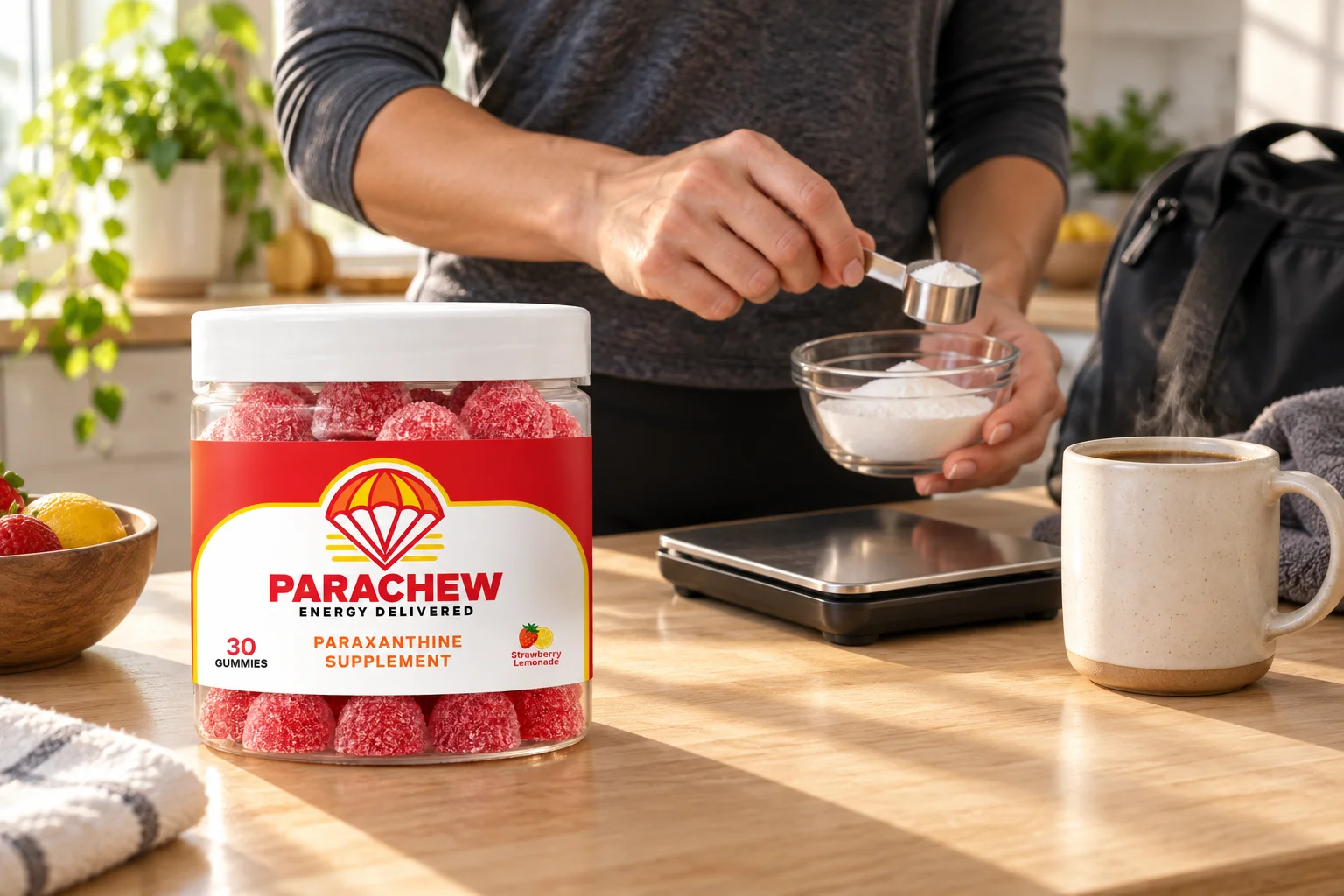
Is paraxanthine powder worth buying? For most people, no: the small savings on raw material cost gets eaten by inconsistent dosing without a scale, and pre-measured Parachew energy gummies or capsules deliver the same 200 mg serving with less guesswork. Powder still makes sense for bulk buyers who already own the equipment to measure it.
By Parachew Team, McAb Nutra
What Is Paraxanthine Powder and How Is It Different From Capsules or Chews?
Paraxanthine is the primary metabolite, the compound your body converts caffeine into, and it's become the base ingredient in a fast-growing category of clean energy supplements. The compound occurs naturally within minutes of drinking coffee, but supplement brands now isolate it directly, often as Enfinity, the trademarked, clinically studied ingredient behind most branded products.
What changes between products is the delivery form, not the compound itself. Powder is the raw ingredient, sold loose and unflavored, with no dose measured in. Capsules take that same powder and pre-measure it into a shell, typically at 100 mg or 200 mg per capsule. Chews, like the Parachew gummy formula, go a step further: each gummy is dosed, flavored, and sugar-coated, so a 200 mg serving requires no measuring at all. The active ingredient can be identical across all three; what you're actually buying is accuracy and convenience.
How Does Paraxanthine Powder's Cost Per 200 mg Compare to Capsules and Chews?
Price alone misses what drives the cost of any 200 mg serving. Four line items make it up, no matter the format:
- Raw material cost: paraxanthine itself, especially the branded Enfinity ingredient, is the single biggest input and roughly the same across formats.
- Processing: encapsulation for capsules and the melt, mold, and coating process for chews add labor and equipment cost raw powder never touches.
- Testing and packaging: purity testing, tamper-evident packaging, and shelf-stability work push finished products, especially chews, higher than bulk powder.
- Format convenience: pre-dosed products carry a premium for the accuracy of not needing your own scale.
Powder usually comes out cheapest per raw milligram since you're paying for the compound and little else. Capsules sit in the middle, and chews carry the highest per-serving cost because flavoring, coating, and testing are the most resource-intensive steps. That gap narrows once you account for waste from an inaccurate scoop, which a pre-dosed serving avoids entirely.
Before comparing any two products on cost, check what's included: does the price cover a certificate of analysis, and is shipping bundled in or billed separately. A powder that looks cheaper on the label can end up costing more per usable 200 mg once you price in a scale you don't already own.
How Do You Measure an Accurate 200 mg Powder Dose Without a Scale?
A scale accurate to at least 0.01 g is the only reliable way to hit a true 200 mg dose from loose powder. Kitchen measuring spoons and the scoops bundled with some containers measure volume, not weight, and paraxanthine powder's density can shift between batches. That means the same level scoop can deliver noticeably more or less than 200 mg depending on how finely the powder was milled.
If you don't already own a scale, the math works against you twice: it's a separate purchase on top of the powder itself, and it has to travel with you every time you dose, whether that's a gym bag, an office desk, or a kitchen counter. Miss the target low and the serving underdelivers; miss it high and you're closer to the daily maximum with less room for a second dose. Capsules and chews sidestep the problem entirely because the dose was measured once, at the factory, under quality control most home setups can't match.

Is Paraxanthine Powder as Effective and Bioavailable as Capsules or Chews?
Bioavailability comes down to the compound, not the capsule or coating around it. Powder, capsules, and chews all deliver the same paraxanthine molecule, and the body absorbs it the same way regardless of format, so a properly measured 200 mg dose of powder is exactly as effective as a 200 mg capsule or gummy. What actually varies between products is consistency, how reliably each unit hits the labeled dose, not effectiveness.
Paraxanthine's clean profile is what separates it from caffeine in the first place: as caffeine's primary metabolite, it produces alertness and focus without the anxious edge, crash, or sleep disruption that can come with a strong cup of coffee. Clinical research on the branded Enfinity ingredient has looked at attention and alertness measures alongside safety data, and the format you buy it in doesn't change the benefits once it's absorbed, only how precisely you can hit the dose you intended.
What Are the Downsides of Buying Powder Instead of Capsules or Chews?
The real downside of powder isn't the compound, it's the format. Loose paraxanthine has no built-in serving size, so every dose depends on your own measuring, and a bitter, unflavored powder is a harder daily habit to stick with than a flavored gummy. It's also more exposed to moisture and air once the container is opened repeatedly, which can affect potency in a way a sealed, single-serve capsule or gummy doesn't.
Paraxanthine's advantage over caffeine holds regardless of format: as the metabolite caffeine breaks down into, it's associated with a cleaner profile, without the jitters, anxiety, or crash. That advantage depends on staying within the daily serving guidance, two 200 mg servings, or 400 mg, as the label maximum. Powder makes it easier to drift past that line by accident, since there's no capsule or gummy count to keep you honest. If it's not clear which format fits your routine, you can contact the Parachew team for guidance before you buy.
Is Paraxanthine Powder Worth Buying Over Capsules or Chews?
Is paraxanthine powder worth buying? It depends on whether you already own the equipment to dose it accurately. Powder earns its place with a narrow group: people who already own a calibrated scale, know how to use it consistently, and buy in high enough volume that the savings on raw cost outweigh the extra prep time. That math shifts further for a gym, studio, or office weighing bulk energy options to serve many people at once, where labor per serving drops as batch size grows.
Everyone else, someone dosing once or twice a day for themselves, gets the best mix of accuracy and convenience from a pre-measured capsule or a dosed gummy that already carries a verified 200 mg serving, without adding another item to an existing supplement stack.
Before buying any paraxanthine powder, check three things. First, ask for a current certificate of analysis showing verified purity, not just a percentage on the label. Second, confirm whether the powder is the branded enfinity ingredient, since it is the paraxanthine used in the published human trials. Third, look at how the brand handles storage guidance and shelf life once opened. Buyers comparing multiple brands side by side benefit from a checklist for caffeine-sensitive shoppers rather than judging each product on price alone.
Frequently Asked Questions
Is paraxanthine powder worth buying over paraxanthine capsules? For most buyers, no. Capsules deliver the same 200 mg dose with no measuring, no scale, and no risk of an inaccurate scoop, while powder only wins on raw ingredient cost. It's worth buying over capsules mainly for high-volume buyers who already own a scale and use enough product that the savings outweigh the extra prep time.
How much does a 200 mg dose of paraxanthine actually cost? There's no fixed number: price depends on the format, testing standards, and whether you're paying for a branded ingredient like Enfinity or a generic source. Powder carries the lowest raw cost per milligram, capsules sit in the middle, and chews cost the most per serving. Compare products by price per dose, not package price.
What is the cheapest way to buy paraxanthine? Bulk powder can be the cheapest way to buy paraxanthine per milligram, since you're paying almost entirely for the compound with none of the processing capsules or chews require. That savings only holds if you own a scale and use enough product regularly to justify buying in volume; otherwise wasted or inaccurate doses erase the discount.
Is paraxanthine powder safe to take every day? Paraxanthine, in any format, is intended for daily use within the label's serving guidance, generally up to 400 mg, or two 200 mg servings, per day. Powder doesn't change the safety profile itself; it just puts more responsibility on you to measure each dose accurately, since going over the daily maximum is easier to do by accident with a scoop than with a pre-counted capsule or gummy.
Can you measure paraxanthine powder accurately without a milligram scale? Not reliably. Kitchen spoons and bundled scoops measure volume, not weight, and paraxanthine powder's density can vary enough between batches that the same level scoop delivers a different dose each time. A scale accurate to at least 0.01 g is the only consistent way to hit a true 200 mg serving from loose powder.
Start With a Dose You Don't Have to Measure
If the comparison above has you leaning toward convenience over a scale and a scoop, the Parachew product page has full serving details for the pre-dosed 200 mg formula in every gummy.


